A Consultant Branding Headshot That Builds Trust

A prospect may visit your LinkedIn profile between meetings, scan your website before booking a call, or see your face beside a proposal that asks for a significant investment. In each case, your consultant branding headshot is doing quiet but consequential work: signaling that you are current, credible, and prepared to represent the outcome you promise.
For independent consultants, a headshot is not a decorative website asset. It is part of the buying experience. Clients cannot evaluate your expertise in a single image, but they do make fast judgments about professionalism, approachability, and fit. The goal is not to look overly corporate or artificially polished. It is to look like the capable person a client will meet on a video call or in a conference room.
Why a consultant headshot carries more weight
Consulting is a trust-led business. Unlike a product purchase, the client is often buying judgment, access, and a working relationship. Your photograph helps reduce the uncertainty that comes before that relationship begins.
A current, well-composed image suggests attention to detail. Clear lighting and a natural expression make you easier to read. Appropriate wardrobe tells visitors you understand the professional context in which they operate. None of these elements replaces a strong case study or referral, but together they remove avoidable friction before a prospect gets to the evidence.
That is especially true when you work independently. A large firm can lean on a familiar logo, a broad team, and an established brand. A solo consultant's expertise and identity are more closely connected. If your photo is ten years old, heavily cropped from a group dinner, or visibly inconsistent with the rest of your presence, it creates a small question you do not need a prospect to ask.
What a strong consultant branding headshot should communicate
The best image depends on your specialty, audience, and price point. A strategy consultant serving enterprise executives may choose a more formal wardrobe and neutral background than a creative consultant working with early-stage founders. The common requirement is coherence: the image should feel aligned with the work you sell.
Credibility without stiffness
Formal does not have to mean severe. A blazer, structured knit, collared shirt, or polished dress can create authority without making you look remote. Choose colors that separate you from the background and photograph cleanly, such as navy, charcoal, deep green, burgundy, or a muted blue.
Avoid clothing with tight patterns, large logos, or high-contrast stripes. These compete with your face at smaller sizes, where many people will first see your headshot. If you normally dress casually for client work, a clean elevated version of that style is often more convincing than an outfit that looks borrowed from someone else's career.
Approachability with a clear point of view
Consultants need to look confident, but confidence does not require a hard expression. A relaxed, subtle smile usually works well for profile photos, team pages, and speaker bios. It communicates availability without becoming overly informal.
Your expression should also match your positioning. If your work involves sensitive leadership decisions, financial risk, legal strategy, or organizational change, calm and composed may fit better than broadly cheerful. If you lead workshops or help clients through creative transformations, a warmer expression can reinforce the energy clients can expect from you.
Recognition across every channel
Your headshot should look like you on a normal, well-rested day. This is where over-retouching creates a real business problem. An image can be technically attractive yet undermine trust if it changes your features, skin texture, face shape, or age so dramatically that a client struggles to recognize you.
Use a recent photo as your standard. Refresh it after a meaningful change in your appearance, role, or positioning, and generally every two to three years. Consistency matters too. Using one recognizable image across LinkedIn, your website, proposals, podcast bios, and Microsoft Teams helps your name and face become easier to recall.
Choose the right visual direction
Before selecting a backdrop or wardrobe, decide where the image will appear most often. This prevents a common mistake: choosing a dramatic photo that looks excellent as a large website banner but becomes unclear inside a small LinkedIn circle.
A neutral light-gray, soft beige, or clean office-style background is a reliable choice for general consulting use. It keeps attention on your face and works with most website designs. A darker backdrop can feel more executive and premium, particularly for leadership, finance, legal, or technology advisory services, but it needs enough contrast to keep the image readable in a small crop.
A softly blurred environmental setting can add context without distracting from you. It can suit real estate advisors, coaches, architects, or consultants whose work is closely tied to place and people. The trade-off is flexibility. A clean studio-style background will typically work across more uses and remain current longer.
Framing matters as much as style. For a primary profile image, use a head-and-shoulders composition with your eyes clearly visible and enough space around your head for different platform crops. A slightly wider waist-up image can be useful for a personal website or speaker page, but it should not replace the close portrait needed for social profiles.
Start with source photos that make quality possible
AI headshot tools can reduce the time, cost, and scheduling involved in a traditional shoot, but the final result still depends on the selfies you provide. Strong source photos give the system more accurate facial information and reduce the chance of odd lighting, distorted features, or an image that feels unlike you.
Use one to six recent photos that show your face clearly from slightly different natural angles. Stand near a window or in evenly lit indoor light, and keep your face unobstructed. Remove sunglasses, hats, and heavy filters. A neutral expression in some photos and a natural smile in others gives more range to work with.
Do not submit only low-light photos, screenshots from video calls, extreme close-ups, or images where another person is cropped out beside you. They may technically show your face, but they make it harder to produce a clean, accurate portrait. If you wear glasses every day with clients, include clear photos of yourself wearing them. The objective is not a generic professional face. It is a polished version of your actual presence.
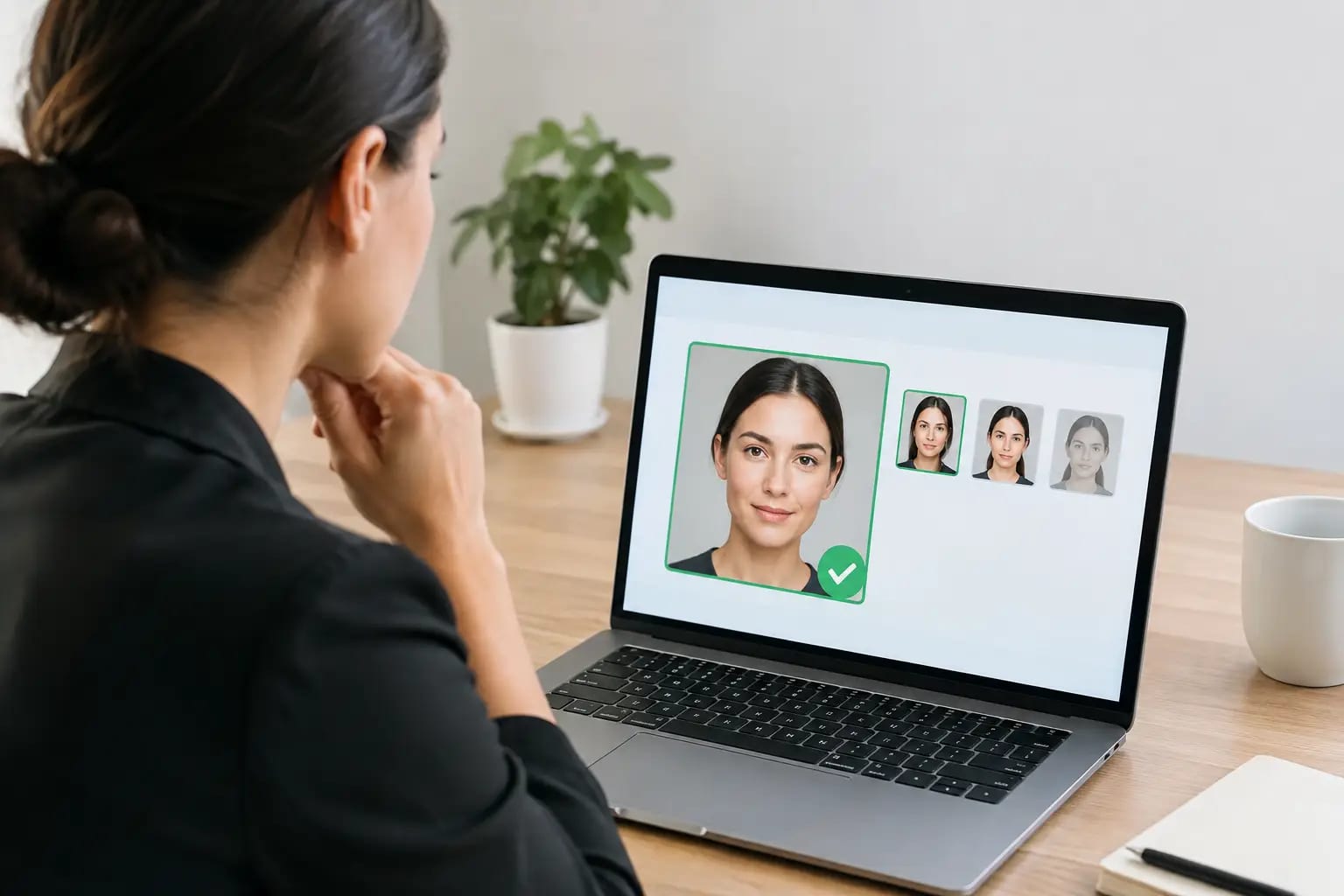
Keeper Headshots uses photo-quality checks before rendering, then evaluates likeness and visible image artifacts after generation. That workflow matters because a generated image should not be accepted simply because it looks polished at first glance. It should be checked for recognizable features, realistic details, clean edges, and a professional finish.
Select the image based on use, not personal preference alone
People often choose the photo where they feel most flattering, even when it is not the strongest business image. A better question is: what does this photo help a prospective client understand about working with me?
For LinkedIn, prioritize clarity, eye contact, and a crop that holds up at a small size. For a consultant website, select the image that fits the surrounding brand colors and service positioning. For speaker bios and press materials, a higher-resolution portrait with a little more space around the shoulders gives editors greater flexibility.
If two options are close, ask a trusted peer or client-facing colleague for a fast comparison. Tell them what you want to convey: executive-level counsel, operational expertise, calm guidance, creative partnership, or technical depth. Their response is more useful than a general question about which image they like better.
Put your headshot to work across the client journey
A good photo loses value when it appears in only one place. Once you have a current image, update the points where clients, partners, and referral sources verify who you are. Start with LinkedIn and your website, then move to proposal templates, scheduling pages, email profiles, speaker materials, directories, and team collaboration tools.
Keep the visual treatment consistent. You do not need the exact same crop everywhere, but the wardrobe, expression, and general session should feel connected. This is particularly useful when a prospect sees you on LinkedIn, receives a proposal, and later joins a call. Familiarity makes the experience feel organized rather than improvised.
For consulting teams, consistency is a separate brand advantage. A team page with mismatched lighting, backgrounds, and image quality can make an otherwise polished firm look fragmented. Coordinated headshots give every consultant an individual presence while helping the company present one clear standard.
A practical standard for your next update
Your headshot is ready when it passes a simple test: it looks current, it looks like you, and it supports the level of work you want to be hired for. It does not need to project perfection. It needs to make the next step - reading your profile, considering your proposal, or booking a conversation - feel easy and credible.
That is the real value of a consultant branding headshot: not a more photogenic version of your career, but a clearer first impression of the professional clients can rely on.